
Why CEO's Lose Their Jobs
I recently participated in a session on Why CEO's Lose Their Jobs with Jon Hockman, McKinley Advisors, Cynthia Mills, The Leaders' Haven, Pat Blake, Former CEO of the Heart Rhythm Society and David Martin, Sterling Martin.
Alignment was the clear lead indicator, the "Core Leadership Truth" of the entire session. CEOs don't lose their jobs overnight; they lose alignment first, often through a "slow drift" that precedes any formal failure.
Note: This video was created in NotebookLM using session notes and AI-generated narration. While designed to capture key themes and insights, some details may not be fully precise.
Why CEO's Lose Their Jobs Key Takeaways
Continuous Evolution
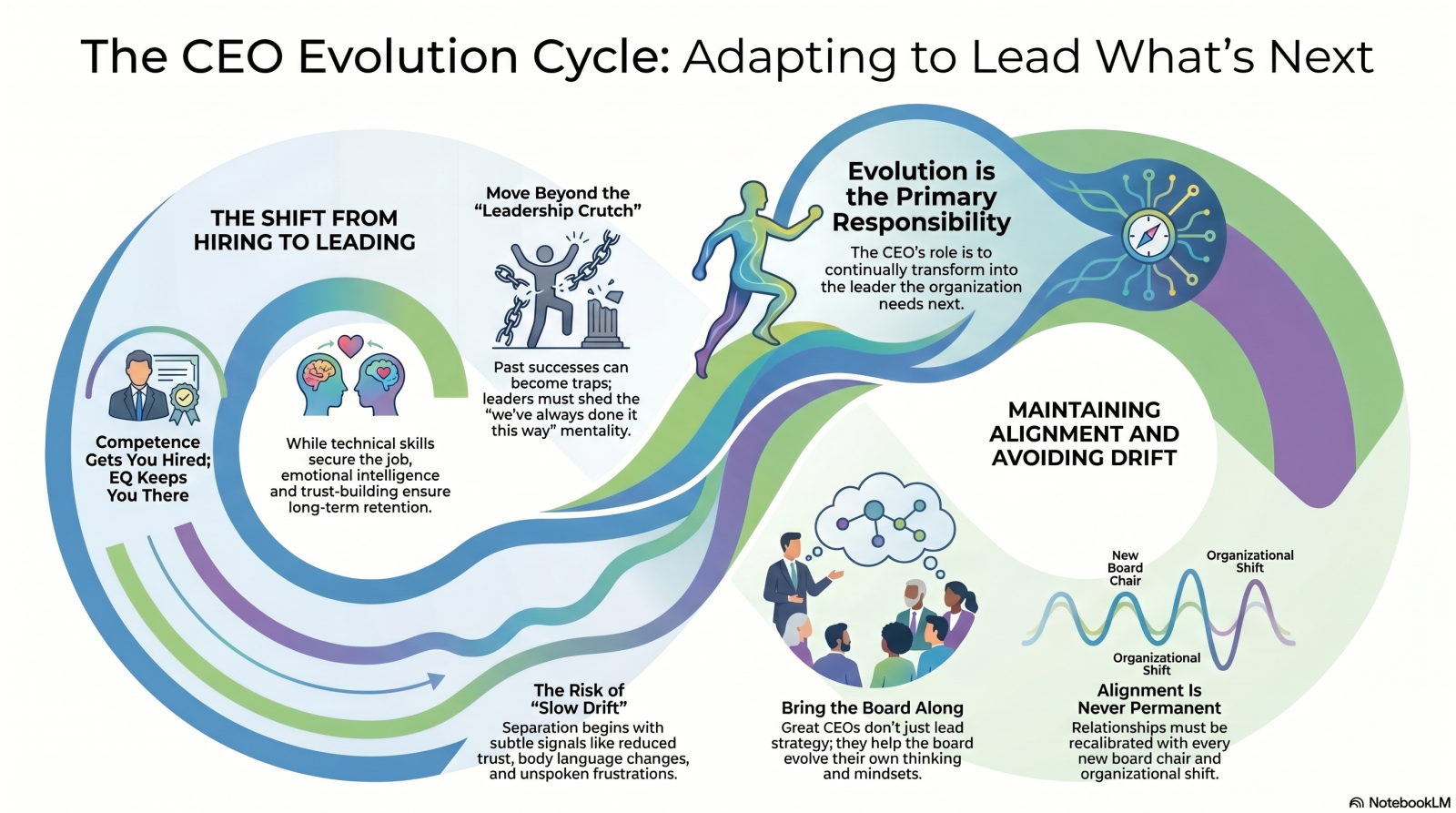
A CEO's responsibility is to "continually evolve into the leader the organization needs now and next" rather than remaining the leader they were when hired. It emphasizes that past success cannot become a "leadership crutch".
One of the most dangerous leadership crutches is relying on the competencies that got you the job in the first place. Long-tenured leaders often fall into the trap of thinking, "I know how this organization works," but the needs of the future rarely match the successes of the past. Past success can unintentionally become a barrier to the growth the organization currently requires.
To stay relevant, you must constantly ask: “Who does this organization need you to become next?”. Organizations, boards, and cultures are in a state of constant flux. Successful CEOs are those who treat their leadership style as something to be continually learned, adapted, and recalibrated to meet those shifting expectations.
Dynamics Over Metrics
There was a clear message that while technical competence gets you hired, emotional intelligence (EQ) and maturity help you stay. Stop asking if you’re hitting your numbers. Start asking: "Where am I drifting? What signals am I missing? And what does this board need from me right now?” Your job isn't just to lead the company; it's to architect the continuity of your own alignment. Success depends on emotional leadership maturity—reading the room, regulating your own reactions, and knowing when to push versus when to pause. Remember that dynamics often outweigh metrics because boards are human systems—not just governance systems.
Pace Mismatch
Board alignment isn't something you "achieve" once; it is something you must maintain daily. As the session notes remind us: “I’m only as good as my last board meeting”. The greatest risk to your tenure isn’t immediate conflict—it is “slow drift,” a gradual separation where the warning signs are often silent and easy to miss.
These signs of separation include reduced trust, disengaged body language, or a "pace mismatch" where the leader moves faster than the board can follow. As the saying goes, “Don’t get so far ahead of the parade they forget you’re in it”. You must ensure the organization has the cultural tolerance and readiness to absorb the changes you are proposing together.
Constant Collection of Evidence
This emphasizes the concept that a CEO is never "off the clock" in the eyes of the board. Every interaction—including tone, body language, and responsiveness—is seen as evidence of your maturity and alignment. Trust is built through radical transparency. Boards do not expect perfection, but they do demand that you communicate good news, bad news, and risks with equal consistency and speed. Furthermore, you must recalibrate for every new Board Chair; you cannot rely on past relationships, as each new chair changes the leadership environment. You must learn to “meet the moment” of what the current chair specifically values.
Long tenure is a double-edged sword
Over time, it is easy to become disconnected or begin viewing the organization as “yours”. Tension can accumulate as dynamics and expectations evolve around you.
We must maintain a sense of humility and remember the fundamental hierarchy of the role: “This is not the CEO’s organization. The CEO works for the board”. Staying aligned over the long term requires a relentless focus on self-awareness and partnership. Every new Board Chair changes the entire environment, requiring you to recalibrate your leadership style all over again.
Quotes that resonated with me:
- On Alignment: "CEOs do not lose their jobs overnight. They lose alignment first."
- On Board Relations: "I’m only as good as my last board meeting."
- On Leadership Evolution: "The organization is constantly asking: 'Who does this organization need you to become next?'"
- On Strategic Speed: "Don’t get so far ahead of the parade they forget you’re in it."
- On Reading the Room: "Are you in touch with how things feel, not just what’s said?"
- On Hiring vs. Tenure: "Competence gets a CEO hired. Emotional intelligence helps them stay."
- On Governance Reality: "Boards are human systems, not just governance systems."
Shoutout to ASAE for hosting Jon Hockman, McKinley Advisors, Cynthia Mills, The Leaders' Haven, Pat Blake, Former CEO of the Heart Rhythm Society and David Martin, Sterling Martin for the wonderful insights.

Angela Kisskeys, President
Associations North