

The 150 Word Habit That Changed My Board Communication
Most board members don’t want more information. They want clarity.
I learned that the hard way. In a previous leadership role, my board updates were long, detailed, and infrequent. I told myself I was being responsible. What I was really doing was asking busy people to work too hard to find the point. When I stepped into a new role, I decided not to repeat that mistake.
The goal was signal, not coverage
Board members read when and where they can. On phones. Between meetings. Often late on a Friday afternoon. I don’t assume they read every update I send.
What I wanted was simpler.
I wanted them to feel a steady pulse from me. To know what mattered right now. To trust they weren’t missing anything important.
A small decision, made early
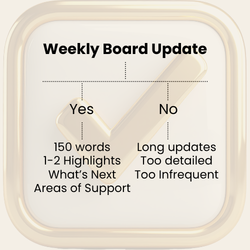 Before my first official week, I committed to a simple experiment. Every week, I would send a board update of about 150 words. I anchored each update to our organizational pillars. That gave the notes a familiar structure and made skimming easier.
Most updates include:
- One or two highlights tied to those pillars
- A brief look at what we’re focused on next
- An ask for how they could support me
Over time, I often included a photo or short personal anecdote as a way to lighten the tone and remind people that real humans are doing the work.
Why Friday afternoons
I send the updates late on Fridays. Not because it’s perfect timing. Because it’s predictable.
Some board members read them right away. Others later that evening or over the weekend. Either way, they aren’t competing with Monday morning inbox chaos.
Consistency does more than clever wording ever will.
Do they read them all? Probably not. Some read every word. Some read a few. Some may just glance at the subject line. And that’s fine.
What matters is that every board member feels informed. They know what we’re working on. They know where my attention is. That shared understanding shows up in better conversations and fewer surprises.
A benefit I didn’t expect
This habit made my own work easier. Those weekly notes became a living record. When it came time to prepare longer board reports, presentations, or one‑on‑one conversations, the material was already there.
Nothing felt sudden. Nothing felt disconnected.
Including staff changed the dynamic
I eventually started copying my staff on these updates. That wasn’t part of the original plan, but it mattered.
Staff could see what I was emphasizing with the board. Board members could trust that staff were seeing the same picture. It created alignment without adding meetings or memos.
What I’d suggest to other CEOs
If you’re rethinking board communication, a few lessons stood out for me:
- Short beats comprehensive. If it can’t fit in 150 words, it needs another forum.
- Pick a rhythm and keep it. The cadence builds trust.
- Write for the phone. Assume fast reading.
- Add a human touch when it fits.
- Don’t judge success by open rates. Look for confidence and shared context over time.
This approach didn’t solve everything. But it changed how connected my board felt. And it made communication feel manageable again.
Sometimes the shift isn’t saying more. It’s saying less, more often.
 Joel Crandall, President + CEO, Minnesota Technology Association
Joel Crandall leads the overall management and strategic direction of Minnesota Technology Association with a focus on enhancing member value and driving community impact. Joel brings a wealth of experience in technology and leadership, having previously worked with Genesys Works and U.S. Bank. Known for his deep care, community-building skills, and commitment to talent development, Joel is dedicated to advancing MnTech’s mission.